
I grew up watching my mother negotiate with truck drivers at the farm gate. Every harvest, the same conversation. She'd ask the price. The driver would name a number she couldn't afford. She'd counter. He'd walk away. And eventually, she'd sell to a local middleman for far less than the Kampala price — because she had no other way to get her beans there.
The problem was never the produce. It was never demand. It was one thing: she didn't have enough cargo to fill a truck by herself, and filling a truck was the only way to get an affordable rate.
That dynamic has locked smallholder farmers out of Uganda's best markets for decades. Share-a-Truck is our answer to it.
The problem with "just find someone to share with"
If you've ever suggested to a farmer that they "just find other farmers to share a truck with," you've never tried to organise it yourself.
Think about what it actually takes. You need three or four farmers whose crops are ready at the same time. They need to be going to the same destination — or close enough that the detour isn't more expensive than the savings. Someone has to take responsibility for booking the truck and collecting payment upfront from the others. And everyone has to trust that nobody will pull out at the last minute, leaving the others to cover a larger share.
In practice, this coordination happens through personal networks — relatives, neighbours, members of the same farming cooperative. And when it works, it's great. But it excludes anyone who doesn't have the right social connections. It fails when relationships are strained. And it can't scale beyond what one person can organise over the phone.
The result: share arrangements happen informally for maybe 15–20% of small farmers, through personal connections. The other 80% either pay full-truck rates they can't afford, sell at the gate to middlemen, or let produce sit until it spoils.
Meet the three farmers
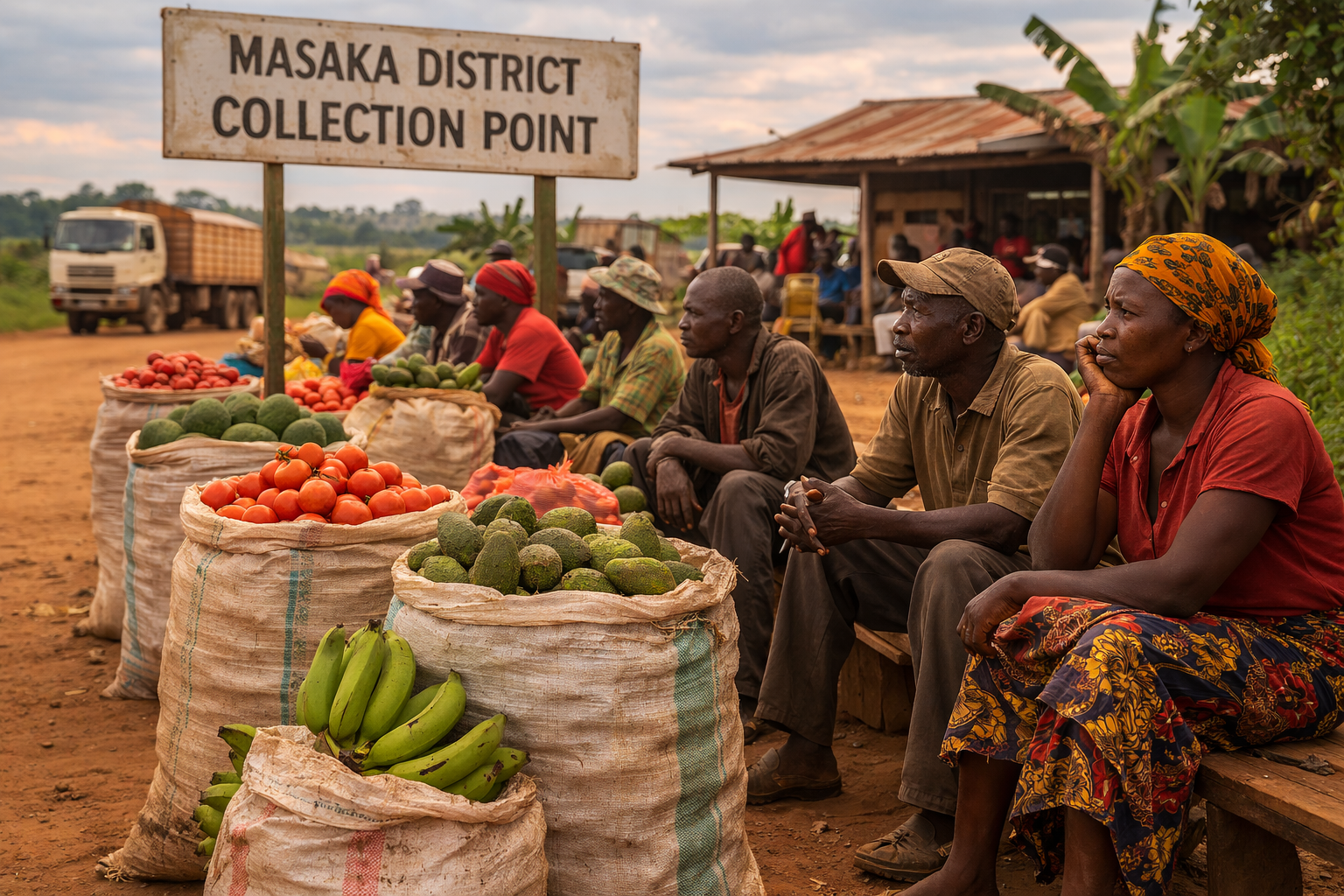
Let me show you what Share-a-Truck looks like in practice, through three real scenarios we've seen play out in our pilot districts.
Three farmers. Same district. Roughly the same destination. All with cargo ready at the same time. Together they have over 2,100 kg of produce — enough to fill a substantial portion of a medium truck. But none of them knows the others exist.
Before FikaConnect, the only way they'd find each other is by chance — at the market, through a mutual contact, or by asking around for days. That search takes time they don't have, especially when produce has a 48-hour window.
What happens on FikaConnect
Here's the same scenario, with Share-a-Truck.
All three list their cargo independently
Mary lists her 8 bags of beans on FikaConnect. John lists his maize. Sarah uses USSD — she dials *123# and follows the prompts. All three set their destination (Kampala) and their ready date (Thursday).
The platform aggregates them automatically
FikaConnect sees three cargo listings going to the same destination from the same district on the same day. It groups them into a single virtual shipment: 24 bags, ~2,160 kg, Masaka → Kampala, Thursday.
A matched driver accepts the combined load
A driver heading Masaka → Kampala on Thursday sees the combined listing in their job feed. The cargo fits. They accept. All three farmers are notified simultaneously — on app, SMS, or USSD depending on what phone they have.
Each farmer pays their share into escrow — separately
Mary, John, and Sarah each pay their third into the FikaConnect escrow via MTN Mobile Money or Airtel. They never have to handle each other's money. The driver is confirmed once all three payments are in.
The truck picks up from each farm gate
The driver routes to all three farms in sequence — their locations are on the app. Each farmer can track the truck live as it approaches. No waiting by the roadside for hours.
Delivery confirmed, each farmer's buyer pays
At Kampala, each farmer's cargo is delivered to their respective buyer. Each confirms delivery on FikaConnect. The driver's payment releases automatically. Each farmer's escrow portion is released to the driver in proportion to their load.
Mary, John, and Sarah never spoke to each other. They never had to agree on anything, negotiate a price together, or trust each other with money. The platform handled all of it.
I did not know these other farmers. FikaConnect found them for me. I paid my share on my phone. The truck came to my gate. That is something I never had before — a truck at my gate for a price I can afford.
— Mary Achieng, Masaka District · Beans farmer, FikaConnect pilot userThe numbers that make it real
Here's what the cost difference looks like, side by side.
That UGX 267,000 difference — per delivery, per harvest — is not a rounding error. For a farmer growing two or three crops a year on a small plot, it can be the difference between profit and loss.
But what about the details people worry about?
Share-a-Truck raises real questions. We hear them from farmers every time we explain it. Here's how the system handles them.
The bigger picture: what aggregation actually changes
Share-a-Truck isn't just a cheaper way to move produce. It changes the fundamental economics of being a small farmer in Uganda.
When a small farmer can access Kampala prices instead of gate prices — reliably, affordably, with GPS tracking and escrow protection — they start to farm differently. They plant more. They time harvests to market demand. They build relationships with buyers who know to expect consistent supply.
The trading company that was previously their only competition for good prices doesn't have a structural advantage anymore. It has scale. But scale isn't the same thing as exclusive access — and Share-a-Truck is what closes that gap.
For the first time I can tell a buyer in Kampala: your beans will arrive on Friday. That certainty — I have never had that before. The price I get now is the Kampala price, not the gate price. — John Okello, Masaka District · Maize and bean farmer
What we're building next
Share-a-Truck today matches farmers going to the same destination on the same day. That's the starting point.
In the next phase of the platform, we're working on pre-harvest aggregation — where farmers can list their crops two to four weeks before they're ready, allowing buyers to pre-purchase and lock in a price before the harvest even happens. This removes the distress-selling dynamic entirely: the truck is booked, the buyer is committed, and the price is fixed before the farmer even starts picking.
We're also building cooperative group accounts, where a farmers' SACCO or cooperative can manage shared listings, track all their members' deliveries in one view, and receive group payments that they distribute internally. This meets farmers where they already organise — in cooperatives — rather than asking them to change how they work.
Share-a-Truck is free to use — join today
If you're a smallholder farmer in Uganda, you can list your cargo on FikaConnect right now. It works on smartphones and basic phones via USSD. No middlemen, no full-truck requirement, no network you have to already belong to.
Read next
Ready to share a truck?
List your cargo now. We'll find the other farmers going your way — and the truck to take you all.