
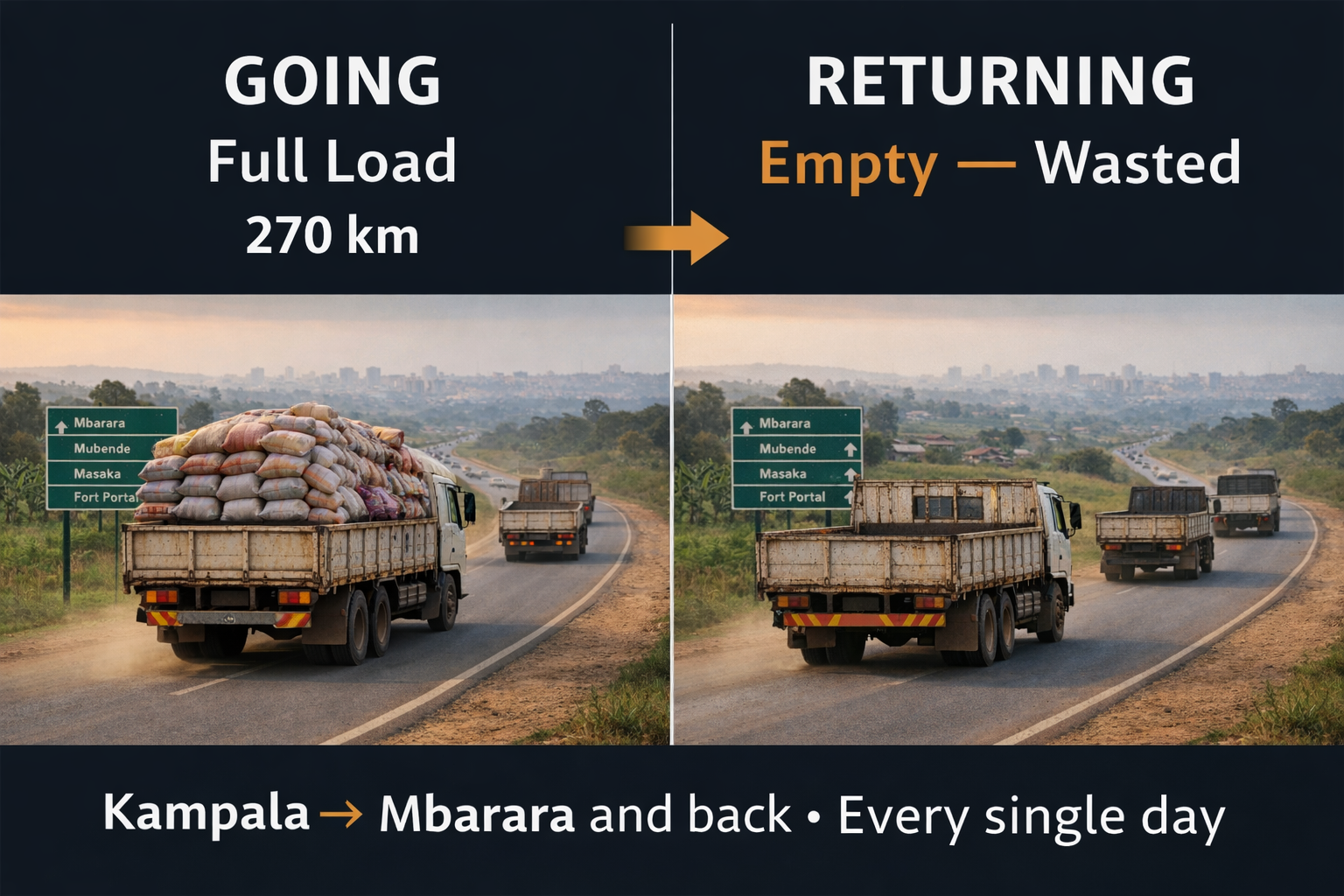
Every day, thousands of trucks make the journey from Kampala to Uganda's farming regions — Mbarara, Mubende, Masaka, Fort Portal. They leave loaded with goods. They return with nothing.
This isn't a secret. Ask any truck driver in Uganda and they'll tell you. But until we started tracking it, no one had measured exactly how widespread it is, what it costs, or — most importantly — whether it's actually fixable.
Over six weeks in early 2026, we tracked 200 truck journeys across central Uganda, interviewing drivers, farmers, and logistics coordinators. Here's what we found.
The scale of the problem
Uganda's agricultural calendar creates a predictable, one-directional flow of goods. During harvest season, trucks move constantly from Kampala toward farming regions: carrying inputs, equipment, and consumer goods on the way out, and produce on the way in.
The problem is that this flow is deeply asymmetric. The produce that needs moving outward — from farm to city — isn't always ready at the same moment the truck is available for the return journey. And because there's no shared information system, drivers and farmers can't find each other in time.
In our study: 82 out of 200 tracked truck journeys returned with zero cargo. On average, those trucks drove 214 kilometres on the return trip, burning approximately UGX 68,000 in fuel and paying the driver UGX 17,000 — with zero income to show for it.
Why it keeps happening
The immediate question is obvious: if there are farmers with goods to move and drivers with empty trucks, why can't they just find each other?
The answer is a coordination failure that's been normalised for so long, most people have stopped questioning it.
No shared information
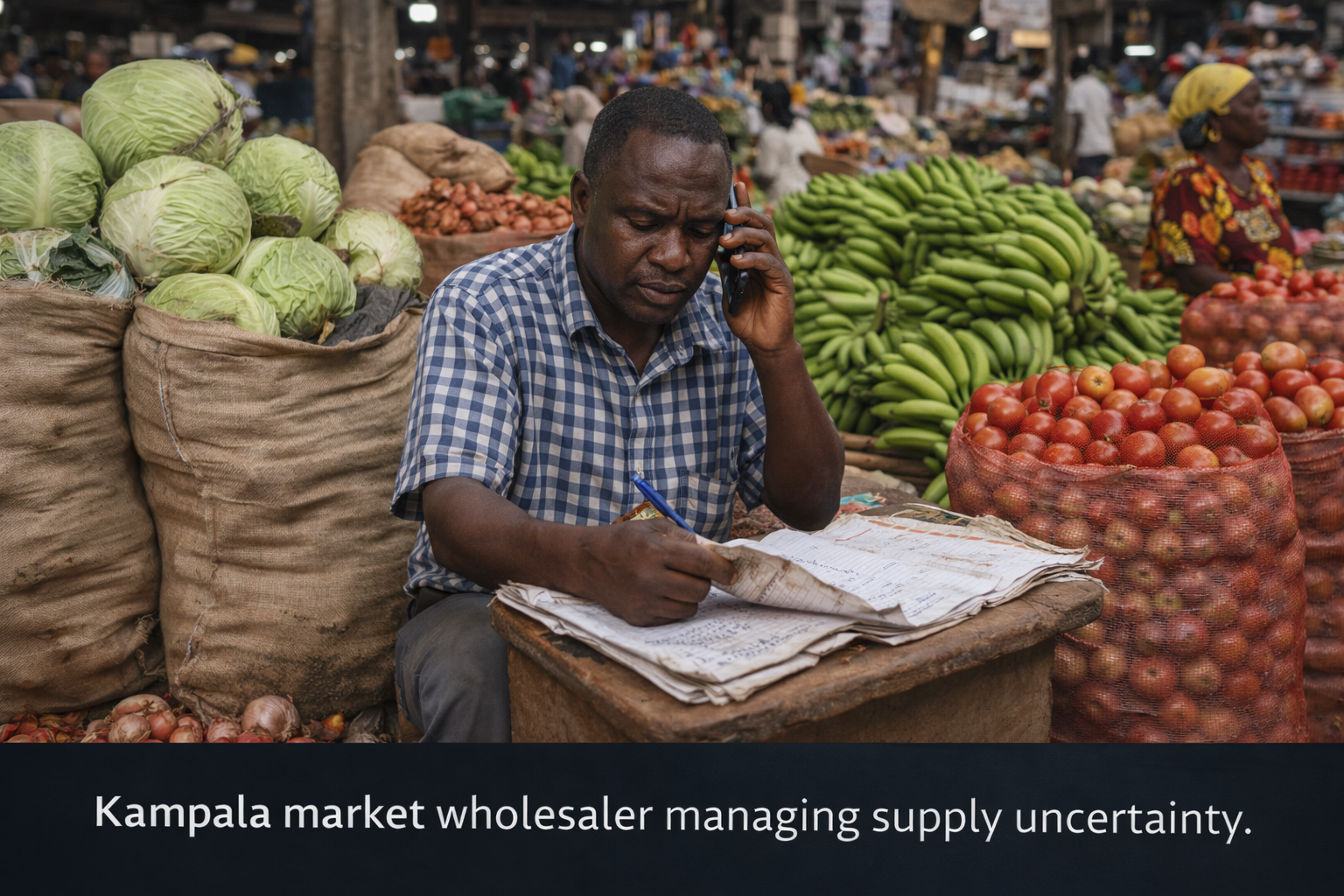
When a driver in Mbarara finishes a delivery, he knows he needs to go back to Kampala. But he has no way to know which farmers in the area have produce ready to move — today, this afternoon, in the next three hours. Farmers who need transport have no way to signal their availability except by making phone calls through personal networks.
The result is that the same driver might spend two hours calling contacts, while a farmer three kilometres away was calling transport companies who never picked up.
Timing mismatch
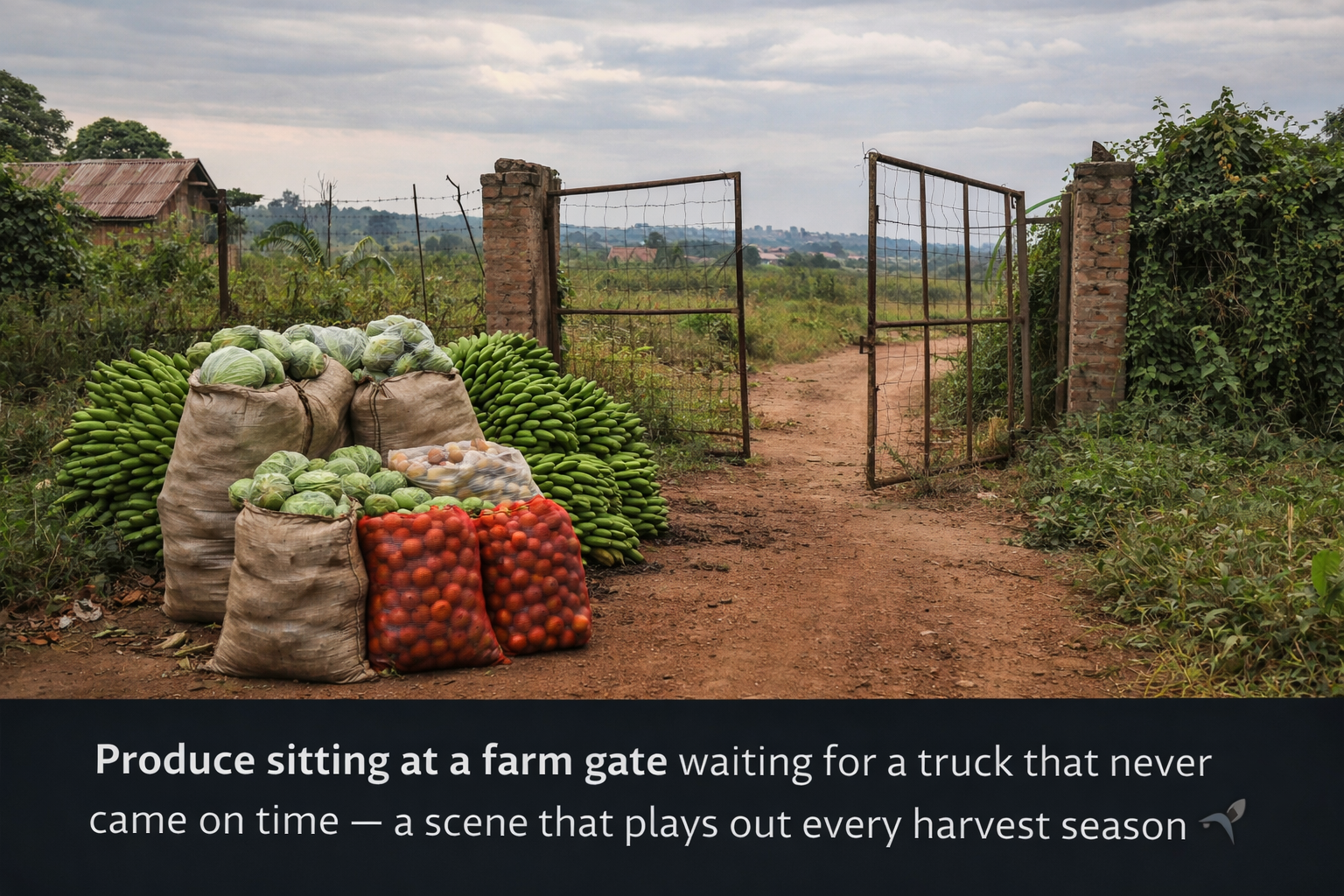
Crops don't wait. When tomatoes are ready, they need to move within 24–48 hours or they start to spoil. But the transport network doesn't run on that kind of urgency — it runs on weekly schedules, established routes, and long-term relationships.
A driver who regularly runs the Kampala–Gulu route doesn't spontaneously reroute to Wakiso because someone's tomatoes are ready. There's no mechanism for that kind of real-time matching.
No trust between strangers
Even when farmers and drivers do find each other through chance — at a market, through a mutual contact, at a petrol station — there's no basis for trust. Drivers have been cheated out of payment. Farmers have had cargo delivered late, damaged, or not at all. Without a verification system, everyone defaults to working only with people they already know.
I drove back from Fort Portal empty fourteen times in one quarter. Every time, I spent two hours trying to find cargo. Every time, nothing. That's UGX 1.2 million I didn't earn — money that was sitting in fields waiting to move.
— Robert Ssemakula, Truck Driver, Kampala–Fort Portal routeWhat this costs — beyond the driver
The obvious victim of dead mileage is the driver who burns fuel with zero return. But the economic damage radiates far wider than that.
The UGX 2 trillion figure sounds abstract. It isn't. That's the price Uganda pays every year for the absence of a simple coordination system.
For context: UGX 2 trillion is roughly equal to Uganda's entire annual health budget. It's not a rounding error — it's a structural tax on the entire agricultural economy that nobody voted for and everyone pays.
The produce that never makes it
There's a secondary crisis that's harder to measure but just as costly: the produce that simply doesn't get transported at all.
When a farmer can't afford full-truck rates and can't find an affordable return-trip option, they sell at the gate — usually to a middleman with a motorcycle or a small pickup. The prices are low. The farmer has no leverage. And the middleman takes the margin that should have stayed in the farmer's pocket.
According to the Uganda Bureau of Statistics, post-harvest losses in Uganda account for between 25% and 40% of total agricultural output annually. A significant portion of those losses aren't caused by pests or weather — they're caused by the simple inability to get food to market in time at a price that makes sense.
My maize was ready in October. I called six transporters. None of them had a truck going to Kampala for three weeks. By the time one came, I had to sell half of it locally at a loss because it couldn't wait.
— Grace Auma, Smallholder Farmer, Lira DistrictWhy this is actually solvable
Dead mileage is not a natural feature of the transport sector. It's an information problem. And information problems — in 2026 — are solvable.
The core challenge is matching: getting the driver who has space on his return trip in front of the farmer who needs cargo moved, at the right time, with enough trust between them to make the transaction happen.
None of that requires new infrastructure. Uganda already has the trucks. It already has the produce. What's missing is the platform that makes them visible to each other.
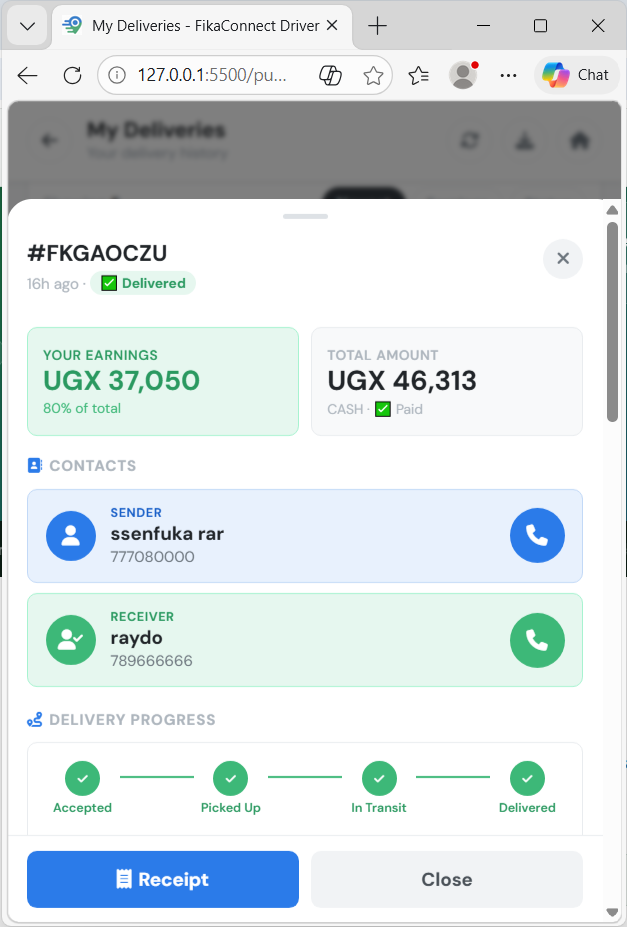 Screenshot: FikaConnect driver dashboard showing return-trip cargo matches. Replace with actual app screenshot.
What FikaConnect does differently
We built FikaConnect specifically around this problem. The dead mileage matching engine is the core of everything we do.
Here's how it works:
- Driver registers their route and schedule — where they're going, when they're leaving, how much space they have on the return.
- Farmers and traders list their cargo — what they need moved, where it's going, when it's ready.
- The platform matches them automatically — showing drivers available cargo on their return route before they even finish their delivery.
- Payment goes into escrow — the farmer's money is held safely until delivery is confirmed. Nobody can be cheated.
- Both sides are verified — every driver has their ID and licence checked before they can take jobs. Every farmer has a confirmed account.
The result: a driver who previously earned nothing on the return trip now earns between UGX 150,000 and UGX 300,000. A farmer who previously paid UGX 400,000 for a full truck now shares that cost with two or three others going the same direction — paying UGX 120,000–180,000 instead.
Both sides win. The driver earns more per trip. The farmer pays significantly less per kilogram moved. The truck that was previously a liability on the return journey becomes a profit centre. And the produce that was previously sitting at the farm gate reaches market in time.
Try FikaConnect — it's free to join
Whether you're a driver, a farmer, or a business that needs reliable supply — FikaConnect is live in Uganda today. No app store needed. Works offline. Installs in 30 seconds.
What comes next
Dead mileage is one of many inefficiencies we're fixing. But it's the one we started with because it has the fastest, most visible payoff for both sides of the transaction.
In the districts where we've piloted the matching system — Wakiso, Kampala, and Mubende — we're already seeing empty return trips drop. Drivers who used to make one profitable journey now make two. Farmers who used to wait three weeks for affordable transport now get matched within 24–48 hours.
We're not under any illusions about the scale of the problem. Fixing Uganda's agricultural supply chain is a decade of work, not a six-month startup sprint. But the dead mileage problem proves something important: the biggest inefficiencies in the system aren't caused by a lack of trucks, produce, or demand — they're caused by the absence of information.
And that's a problem we know how to solve.
Read next
Join FikaConnect — it's free.
Farmer, driver, or business. Sign up in 2 minutes. Works on any phone in Uganda.